

PARTNERSHIP PROFILES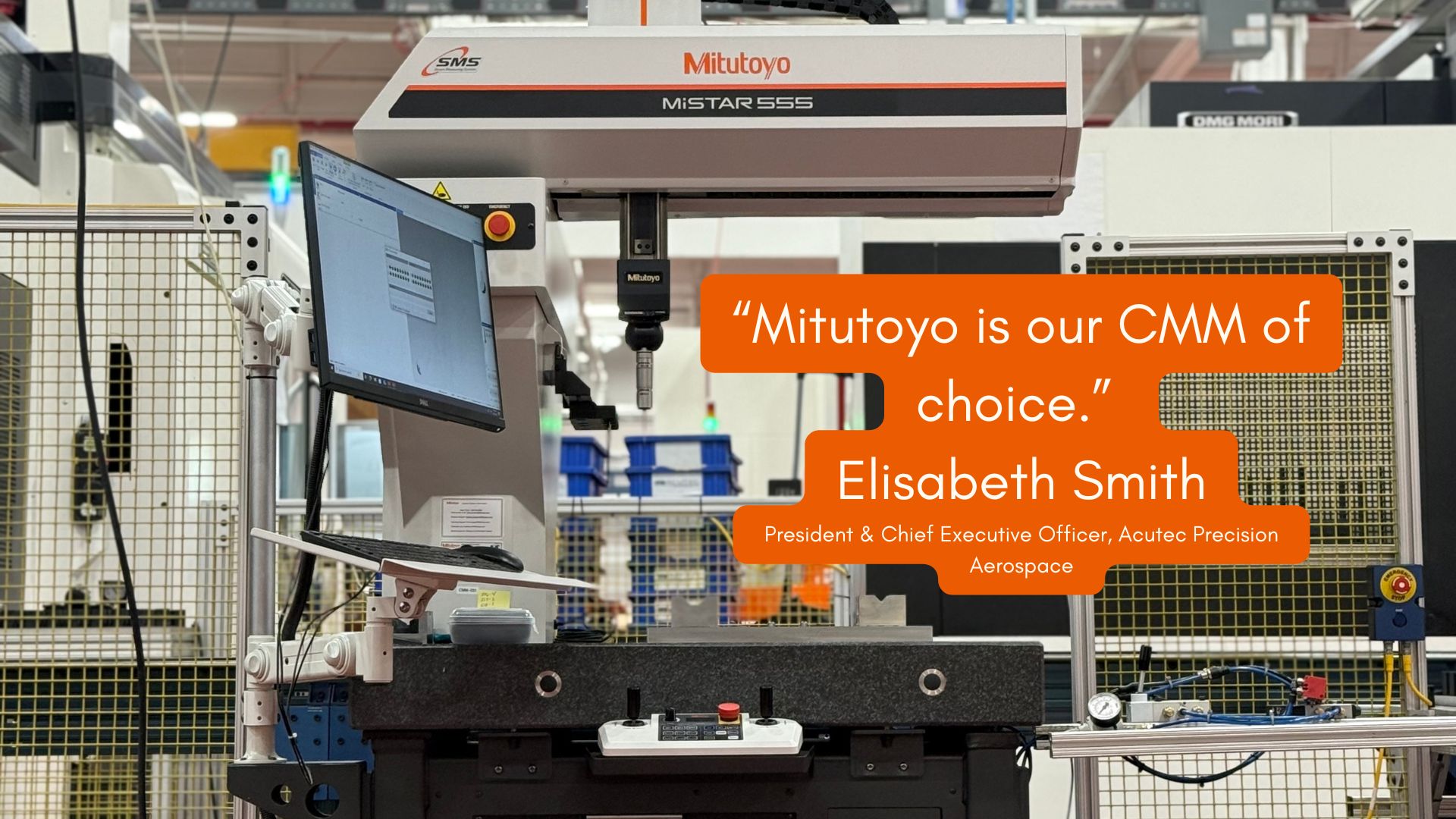
Acutec Precision Aerospace, based in Meadville, Pennsylvania, is a leading manufacturer of critical components for the aerospace and defense sectors. Since its founding in 1988, the company has grown to over 500 employees and built a strong reputation for quality and innovation. The Acutec automation integration team has developed world-class capabilities, by automating processes across a variety of materials in a high-mix environment with volatile forecasts. With 10 inspection and calibration labs and more than 20 coordinate measuring machines (CMMs) in operation across 450,000 square feet of production space, Acutec supports a vision of creating a high-output, flex-labor manufacturing environment that is adaptable, resilient, and ready for the future. As a result of its partnership with Mitutoyo, Acutec has realized countless gains in productivity and the overall quality of the product shipping to their customers.
Mitutoyo America Corporation is a global provider of dimensional metrology solutions with the industry’s most comprehensive range of more than 5,500 precision measurement instruments, tools, and equipment. Mitutoyo manufactures every product in its own facilities in Japan, ensuring each instrument meets its own stringent quality and precision standards. Employing over 400 people across the U.S., Mitutoyo America Corporation has eight regional M³ Solution Centers across the United States to ensure customers, like Acutec, receive responsive, expert support whenever a customer needs it.
CHALLENGE 1 of 2: MANUFACTURING
When Acutec commissioned its trio of DMG NZX 2000 nine-axis mill-turn centers, the automation strategy sounded straightforward with a single focus on keeping the spindles cutting a high-mix of components 24/7 with as little human intervention as possible.
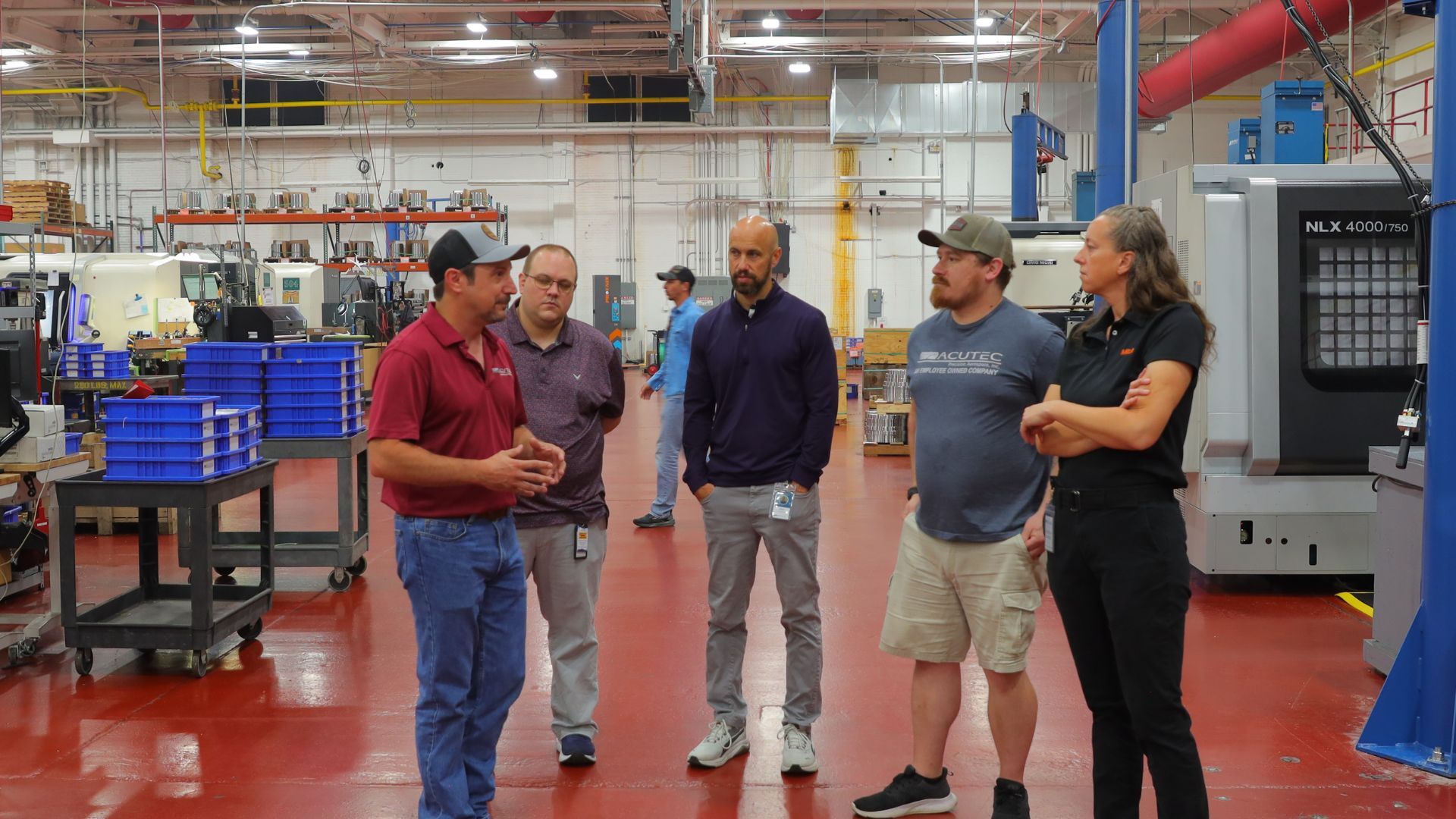
Engineers and quality managers knew having three minimally staffed 9-axis CNC machines producing nine distinct parts across three-part families would be a challenge and they quickly discovered that pushing parts through the machines faster only created a new bottleneck, which was off-line inspection. Efficient and effective metrology has been a staple at Acutec. They are no strangers to CNC inspection equipment and have successfully implemented numerous Mitutoyo CNC CMMs throughout their facilities. This project called for metrology to be taken from a different viewpoint.
The traditional model CMM inspecting parts for quality was located in a temperature-controlledquality lab which required operators to pull a sample from the manufacturing line, walk it across the shop to the lab, and wait their turn before being able to measure and acquire important dimensional data.
Without immediate feedback, small issues such as tool wear, chip recut, or thermal growth could lurk undetected for hours, pushing part features out of spec and building an invisible pile of scrap. In an unattended shift, a single drifting cutter could generate dozens of non-conforming parts before anyone noticed, an expensive way to learn about needing closed-loop control.
The logistics of the old inspection loop compounded the problem. Every time a machinist left the cell to ferry parts to the lab, machining uptime suffered. Once the parts arrived, a growing backlog in the lab created scheduling headaches and forced re-work when parts failed inspectionafter the machining window had closed, eroding customer confidence by stretching lead times and increasing the risk of missed delivery dates.
That is when Acutec approached Mitutoyo America Corporation to help solve this unique set of problems and get the company’s production running as fast and efficiently as they first envisioned.
 SOLUTION 1 of 2
Acutec took the approach of utilizing the Mitutoyo MiSTAR 555 CNC CMM for in-line metrology with closed loop data control and a Fanuc 10 iA/L robotic arm to work as a single, self-correcting system to measure parts in real time without human intervention.
Since the MiSTAR guarantees dimensional accuracy across a wide 50 °F – 104 °F temperature range and resists oil and other contaminants thanks to its specially designed Mitutoyo ABSOLUTE scales, Acutec was able to place the MiSTAR right next to the mill-turn machines. This allowed the robotic arm to grab a part the moment the part was finished on a mill-turn machine, move it through a wash and blow-off stage, and then place the part on the MiSTAR’stable.
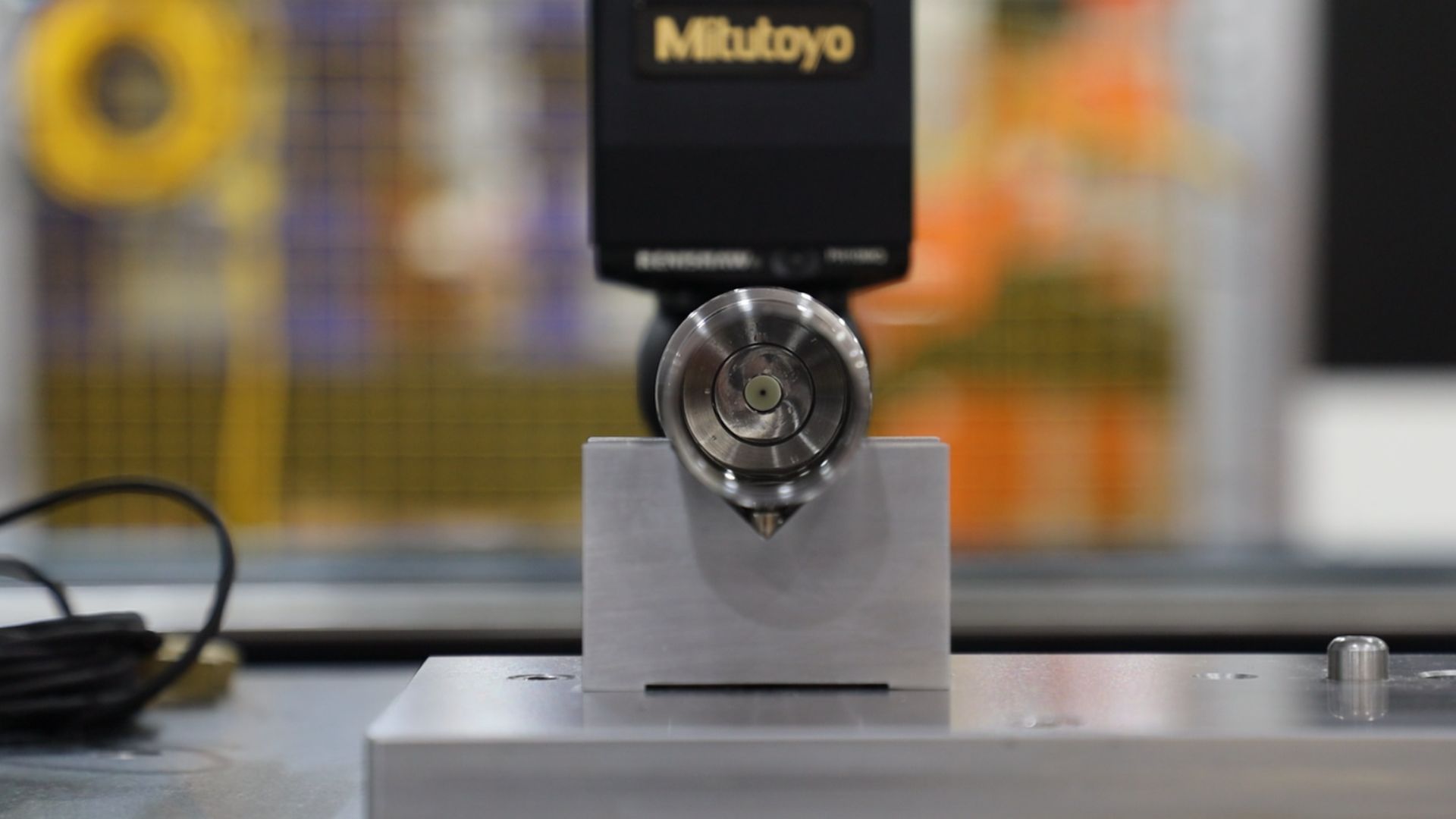
This setup was further enhanced by the MiSTAR’s advanced probing capabilities, which were essential for keeping up with the complexity and variation of Acutec’s parts. Equipped with an automatic indexing probe head, the MiSTAR could quickly reorient to access challenging geometries without manual adjustment. Its contact scanning sensor enabled continuous surface measurement, ideal for capturing form and profile features with high accuracy. Combined with an automatic stylus change rack, the system could switch between multiple styli configurations on the fly, without interrupting the cycle, ensuring that even intricate, multi-feature parts were fully inspected in one seamless routine. This flexibility allowed Acutec to maintain precision and throughput, even in a high-mix, low-touch production environment.
Once the part was on the MiSTAR table, the CMM measured the part in seconds while streaming the results straight back to the cell controller via Mitutoyo MCOSMOS CMM software and MeasurLink® SPC software. This resulted in much faster in-line measurements that were highly accurate and gave operators and quality managers the ability to see inspection results as soon as the part came off the machine. If all features were found to be within control limits, the robot automatically staged the part downstream and cued the next machining cycle without human involvement. If any feature began to drift, the same data pipeline would either update the relevant tool offsets or pause the affected spindle. This meant tool wear and part-to-part variations could be corrected during production rather than hours later when a batch of parts finally reach the CMM for inspection.
This instant feedback loop slashed inspection lead-time by roughly 80%, freed a full-time in-process inspector for higher-value work, and allowed Acutec to run genuine unmanned shifts with the confidence that quality problems will be caught within three parts instead of thirty.
While the resulting time savings were a huge windfall for Acutec, the challenges didn’t end there.
CHALLENGE 2 of 2: INTEGRATION & CUSTOMIZATION
Acutec initially saw strong results with stand-alone, robotically tended CMM stations, supported by close collaboration with Mitutoyo engineers and Field Service team. Mitutoyo fine-tuned the standard MiSTAR 555 CMM setup to meet Acutec’s vision of fully autonomous, high-mix part inspection. While the MiSTAR successfully addressed the core quality challenge, additional integration work was needed to create a truly hands-off system capable of inspecting nine distinct parts across three-part families from three different mill-turn machines.
The MiSTAR performed well in single-part scenarios, but the automated line required it to instantly identify multiple distinct incoming parts, launch the correct inspection routine for each part, and return a pass/fail signal without manual input or slowing production. Through constant collaboration between Acutec and Mitutoyo, Mitutoyo engineers were able to deliver what Acutec wanted by implementing small adjustments to the original out-of-the-box solution.
SOLUTION 2 of 2
In order to get the MiSTAR 555 to recognize the part type automatically and launch the appropriate inspection routine, the Mitutoyo team created logic that responded to the robot’s actions in real time, enabling the MiSTAR to initiate the correct measurement program, select the appropriate probe, and signal completion only after all data was collected and exported to data management and SPC software. This level of integration transformed the MiSTAR from a standalone measurement device into a fully integrated part of the automation cell that contained three different mill-turn machines creating different parts, actively participating in the production flow.
To overcome recurring reliability issues with barcode and QR code scanning caused by glare, dust, and coolant on the shop floor, Acutec and Mitutoyo moved away from optical identification. Instead, they implemented a robust, direct signaling approach that allowed the system to identify which part was being measured instantly and without error.
Since its rollout, this streamlined setup has delivered flawless performance, eliminating scan failures and unnecessary downtime. It also ensured that each measurement report was directly tied to the correct part number and lot in real time, enabling rapid tool adjustments and maintaining statistical control, even unmanned, all hours of the day.
RESULTS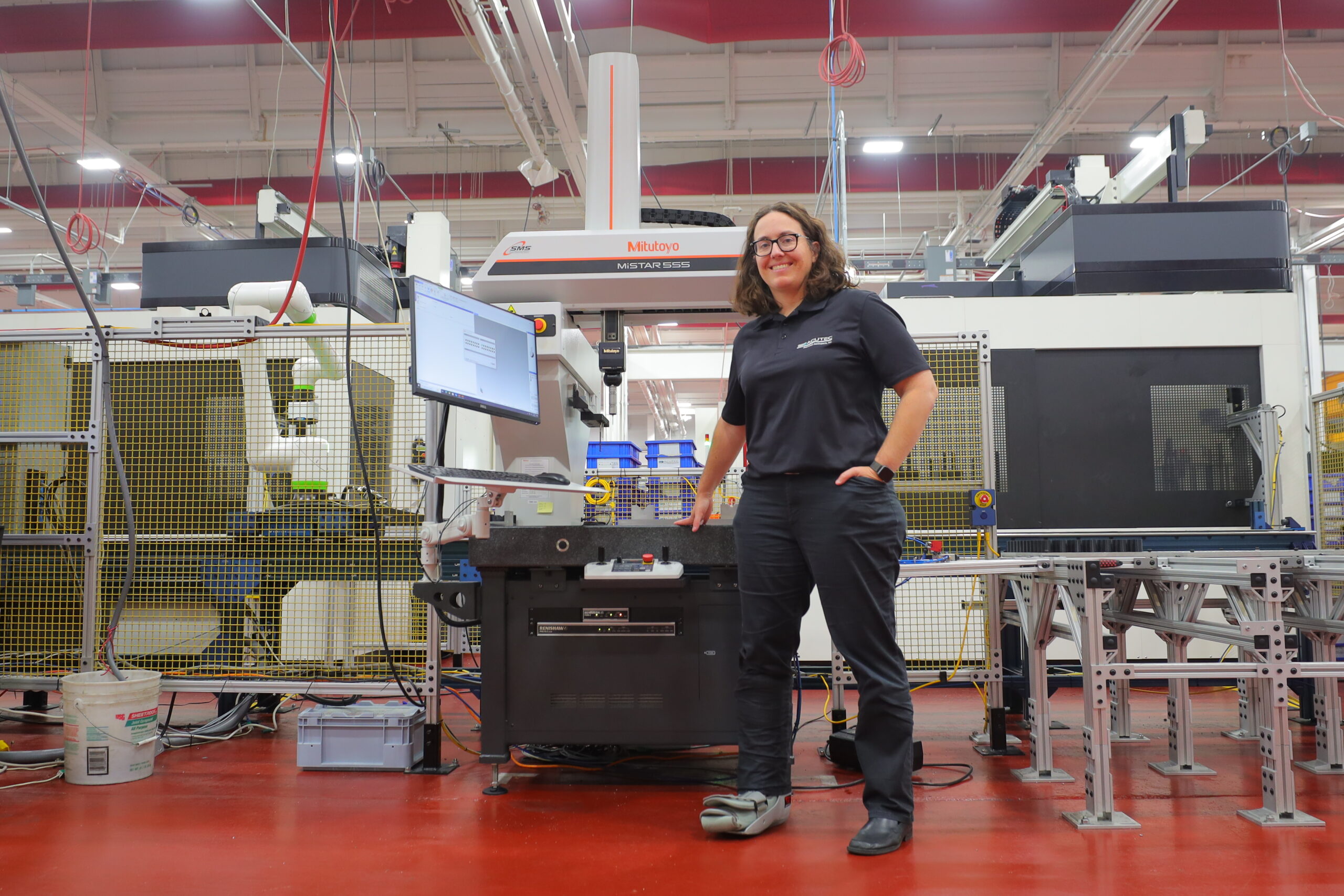
By moving critical part inspections out of the metrology lab, which was located away from the manufacturing line, and into the automated production cell, Acutec reduced its “wait for results” portion of its overall process to essentially zero. Each part now traveled directly from the mill-turn machines to the MiSTAR 555 where probing and pass/fail logic ran in parallel with the part’s machining. As a result, an in-process check that once consumed several minutes of wait time now finished in roughly 20% of the original duration.
Across three mill-turn machines and multiple shifts, Acutec realized an 80% reduction in cumulative inspection time that freed up operators to stay at the machine spindle instead of ferrying part samples across the shop for inspection. That reduction in inspection time led to noticeable savings in labor costs, allowing Acutec to redeploy about $40,000 a year in inspection headcount to more value-adding tasks elsewhere in its manufacturing facility.
The savings didn’t stop there, either.
The real-time SPC feedback integrated into the automated cell eliminated virtually all hidden scrap since tool-wear drift was caught within three consecutive parts. The automated cell was able to recognize, and then pause, only the machine with tool-wear drift while the other two machines continued to product in-spec parts which preserved throughput while keeping material costs in check. In short, the inline, closed-loop strategy Acutec and Mitutoyo partnered to develop, has delivered faster cycles, leaner labor usage, and a measurable drop in rework, all of which feed directly into higher schedule reliability and stronger customer confidence. Together, Acutec and Mitutoyo continue to push the boundaries of what is possible in today’s ever-evolving manufacturing field.